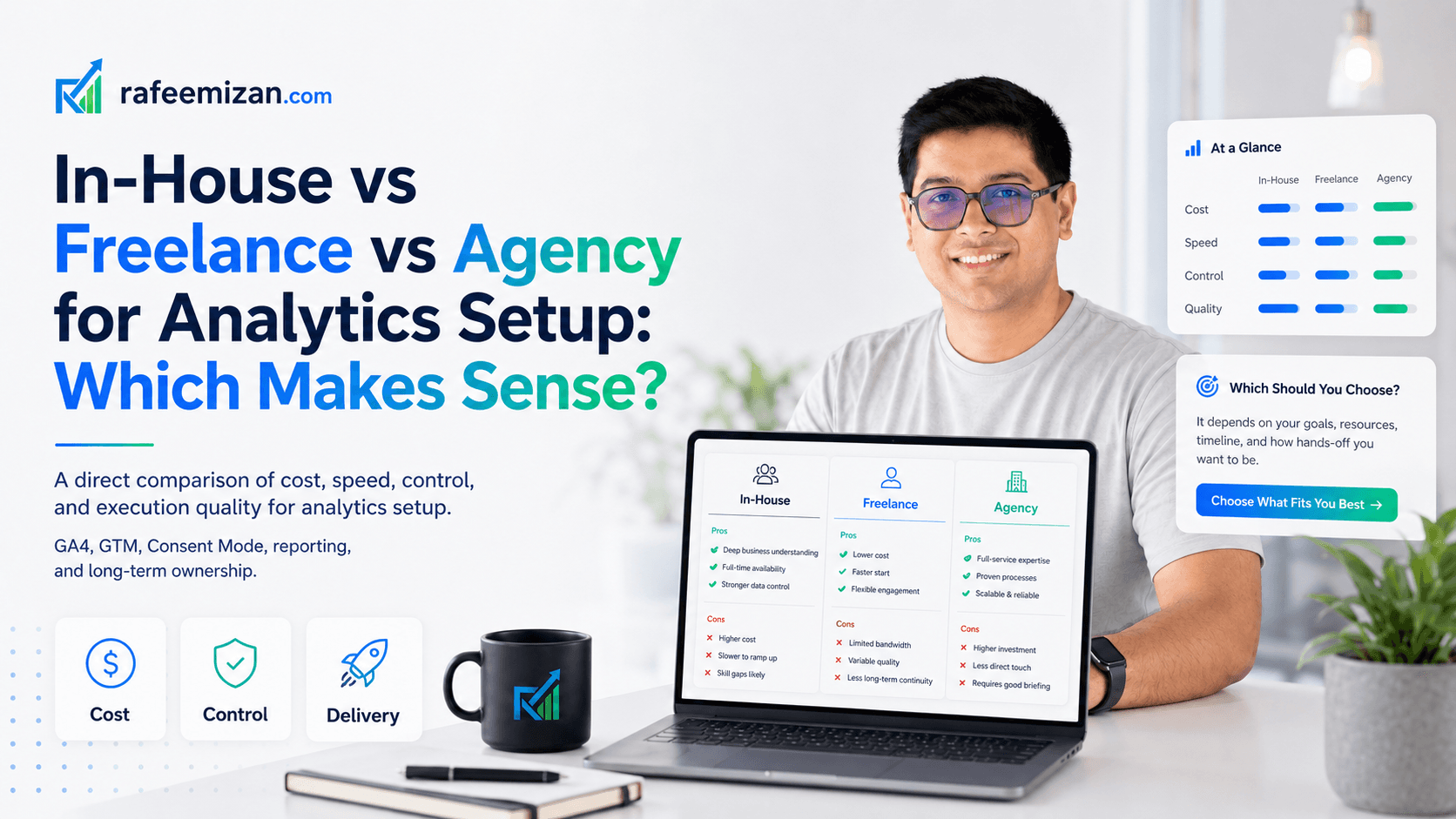
When you realize your analytics is broken or you need a proper tracking setup, you have three realistic options: hire someone in-house, work with a freelancer, or hire an agency. Each has trade-offs that depend entirely on your situation.
Here is a direct comparison based on what I have seen from the inside of all three models.
The in-house option
Hiring a digital analyst or marketing operations person in-house means you have someone permanently responsible for analytics quality, reporting, and tracking.
When it makes sense:
You have a complex, fast-moving marketing setup with multiple platforms, frequent campaigns, and an ongoing need for someone who deeply understands your data. At this scale, having someone internal who knows the full context is genuinely valuable.
You process significant volumes of personally identifiable data and need someone accountable for ongoing compliance oversight.
You have the budget. A mid-level marketing analyst or marketing ops hire in Sweden or the UK costs 45,000 to 70,000 EUR/year (salary only, before overhead). A senior analytics hire is more.
When it does not make sense:
You need analytics expertise but not full-time. A good GA4 implementation takes weeks, not years. Hiring someone full-time to do what is fundamentally a project-based task is expensive and often leads to scope creep and invented work.
You are a small or mid-market business that does not have the volume to keep a dedicated analyst meaningfully occupied. Many businesses in this position hire a junior analyst, get mediocre work, and then need to bring in external help anyway.
The honest reality: Most businesses that think they need a full-time analyst actually need a good freelancer or agency for implementation and occasional check-ins. The bar for full-time makes sense is higher than most people assume.
The freelancer option
A freelance analytics consultant handles the specific work you need — an implementation, an audit, a training program, ongoing maintenance — without a permanent employment commitment.
When it makes sense:
You have a defined project. A GA4 setup, a consent implementation, a tracking audit, a campaign setup. Freelancers are most cost-effective for scoped work with clear deliverables.
You want senior expertise at a lower total cost than an agency. A freelancer typically has lower overhead than an agency and passes that on in pricing. You often get more experienced work at a lower rate than an agency using junior staff.
You want direct communication. With a freelancer, the person you spoke to during the sales conversation is the person doing the work. No account managers, no delegation to a junior.
You need flexibility. Freelancers can be engaged for a project and then retained monthly as needed, without a long-term commitment.
When it does not make sense:
You need simultaneous capacity across multiple disciplines (analytics + creative + paid media + SEO) and want one point of accountability for all of it. A single freelancer covers one or two areas; agencies cover more under one contract.
You need the perceived credibility of a named agency for internal stakeholders. Some organizations require vendors to be incorporated companies with formal processes. Freelancers may not meet procurement requirements in large enterprises.
The work is genuinely full-time and ongoing without clear project boundaries. If you need someone embedded in your team day-to-day, employment makes more sense than an ongoing freelance arrangement.
The honest reality: For most SMBs and mid-market businesses, a good freelancer is the best value option for analytics work. You get expertise, direct communication, and flexible engagement without paying for agency overhead.
The agency option
A digital marketing agency handles analytics as part of a broader service offering, usually alongside paid media management, SEO, or content.
When it makes sense:
You want one vendor to manage multiple channels together. If you need analytics, paid media, and SEO coordinated under a single strategy, an agency that covers all three removes coordination overhead.
You are a larger organization with formal procurement and vendor management requirements. Agencies are often easier to contract with, have formal service agreements, and are simpler to invoice in larger organizational structures.
You need ongoing campaign management at volume. Agencies are set up for ongoing retainer work across multiple simultaneous campaigns.
When it does not make sense:
You just need analytics fixed. If the specific need is GA4 setup or consent implementation, most agencies will still charge you for account management, project management, and junior staff time on top of the specialist doing the actual work. You pay more and often get less senior expertise.
You want to know who is actually doing the work. At many agencies, analytics is done by a generalist account manager with some platform experience, or outsourced entirely. The expertise level varies significantly.
You want quick turnarounds. Agencies have scheduling constraints, multiple clients, and approval processes. A freelancer can often start the same week.
The honest reality: Agencies are good for breadth and ongoing campaign volume. For specific technical work like analytics implementation, you often get better expertise at a lower cost from a specialist freelancer.
A rough cost comparison
For a GA4 + GTM implementation + Consent Mode v2 setup:
- In-house: Not applicable (you need a project, not a hire)
- Freelancer: 1,500 to 4,500 EUR (project rate)
- Agency: 3,000 to 8,000 EUR (project rate with overhead)
For ongoing analytics maintenance (monthly):
- In-house: 4,000 to 6,000 EUR/month (salary + overhead for one person)
- Freelancer: 400 to 800 EUR/month (retainer for maintenance)
- Agency: 800 to 2,000 EUR/month (retainer with account management overhead)
How to decide
Start from the question: is this a project or a permanent function?
If it is a project with a clear end state, use a freelancer or agency. Compare on expertise, communication style, and cost.
If it is a permanent function you need someone accountable for full-time, hire in-house.
Most businesses are better served by a combination: a freelancer or specialist agency for implementation and setup, then a lighter maintenance retainer, with in-house team members trained to use and interpret the data.
If you are evaluating your options and want a direct conversation about whether I am the right fit for your analytics work, get in touch. I will tell you honestly if you should be looking at a different option.