Server-side tracking gets pitched as the solution to every analytics problem. Ad blockers, ITP, Consent Mode gaps, data quality — the answer is always "go server-side." The reality is more nuanced.
Here is an honest breakdown of what it actually costs, what it fixes, and when it makes sense.
What server-side tracking actually does
In a standard client-side setup, your browser loads the tag manager, which loads and fires tags directly to Google, Meta, and other platforms. Everything happens in the user's browser.
Server-side tracking moves the tag firing to a server you control. Your website sends a single event to your server, and your server fans that event out to GA4, Google Ads, Meta CAPI, LinkedIn, and wherever else it needs to go.
The user's browser only talks to your server. The server talks to the ad platforms.
What this actually fixes
Ad blockers and browser extensions — Most ad blockers target known tracking domains (google-analytics.com, connect.facebook.net). When requests come from your own domain, they are not blocked. You recover 10-30% of lost data depending on your audience.
ITP and cookie restrictions — Safari's ITP limits first-party cookie lifespans. With server-side tracking, cookies can be set as true first-party server cookies, extending attribution windows from 7 days back to 30, 60, or 90 days.
Data quality control — You decide what data gets sent to each platform. PII can be stripped before it reaches Google or Meta. Events can be enriched with server-side context before being forwarded.
Reduced page load impact — Instead of loading 5-10 vendor scripts in the browser, you load one. This has a measurable effect on page speed.
What it does not fix
Server-side tracking does not solve consent. If a user declines cookies, you still should not track them — your server should respect that choice. A server-side setup that ignores consent is a bigger GDPR problem than a client-side one, because it is harder to audit.
It also does not fix broken event taxonomies, bad conversion logic, or attribution model problems. Bad data on the client side becomes bad data on the server side.
What does it actually cost?
This is where most articles go vague. Here are real numbers.
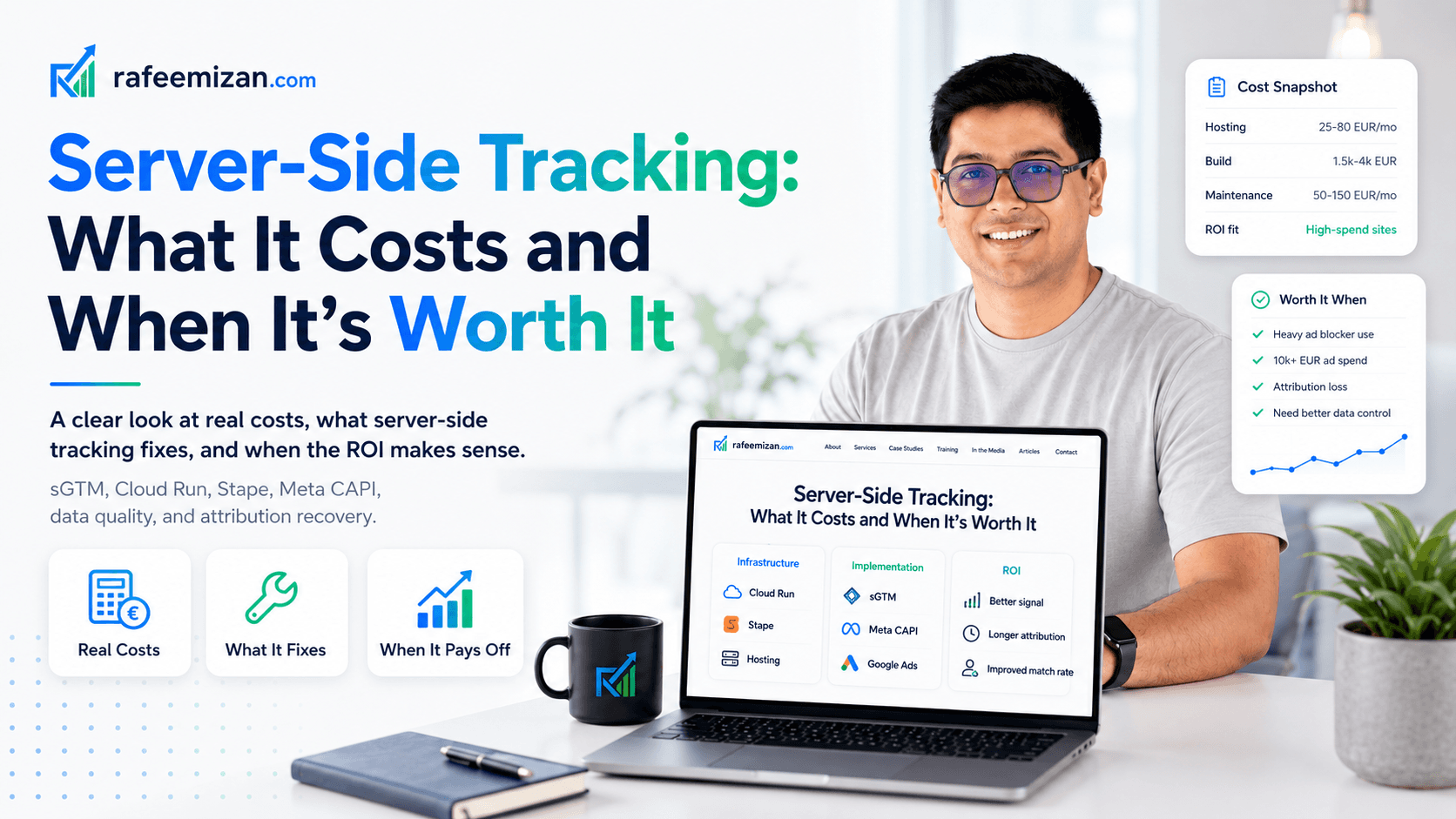
Infrastructure: Google Tag Manager Server-Side requires a server. The cheapest option is Google Cloud Run, which costs approximately 25-80 EUR/month for a small to medium traffic site. For higher traffic or production-grade setups with redundancy, expect 150-400 EUR/month. Stape.io offers managed sGTM hosting from around 29 EUR/month and is a good option for businesses that do not want to manage infrastructure themselves.
Implementation: A professional server-side GTM setup takes 15-40 hours depending on the number of vendors and complexity of event taxonomy. At typical consulting rates, expect 1,500 to 4,000 EUR for implementation. Adding Meta CAPI, LinkedIn CAPI, and Google Ads enhanced conversions alongside expands the scope.
Ongoing maintenance: Server-side containers need updates when vendor APIs change. Budget 50-150 EUR/month for a basic maintenance retainer.
Total first-year cost estimate:
- Small site (low traffic, 2-3 vendors): 2,500 to 5,000 EUR
- Medium site (significant traffic, 4-6 vendors): 4,000 to 9,000 EUR
- Enterprise: scope separately
When it makes sense
Your audience uses ad blockers heavily. If you are in tech, developer tools, security, or B2B SaaS, 30-50% of your traffic may be blocking client-side scripts. You are running campaigns with significantly incomplete conversion data.
You run high-spend paid media campaigns. If you are spending 10,000 EUR+ per month on Google Ads or Meta, a 20% improvement in conversion signal quality can have a direct positive ROI within months.
You need extended attribution windows. E-commerce businesses with long research cycles suffer from ITP-related attribution loss. Recovering 60-day attribution via server cookies can meaningfully change how campaigns are optimized.
You have data privacy requirements. Healthcare, finance, and legal businesses dealing with sensitive data benefit from server-side filtering before data reaches ad platforms.
When it does not make sense yet
If your site gets under 10,000 monthly sessions and you spend less than 3,000 EUR/month on ads, the math usually does not work.
If your client-side setup is broken, fix that first. Server-side tracking built on top of bad event taxonomy just makes the problems faster and more expensive.
What to do instead if you are not ready for server-side
- Fix Consent Mode v2 properly — this recovers a significant portion of lost conversions through Google's modelling
- Enable Enhanced Conversions in Google Ads — uses hashed first-party data to improve conversion matching
- Use Meta's Conversions API alongside the Pixel — can be set up without full server-side infrastructure using tools like Stape's CAPI Gateway
- Configure GA4 data retention and session parameters correctly
These steps will get you most of the benefit at a fraction of the cost.
I walked through this exact cost/benefit tradeoff for a renewable energy provider, where the audit findings shaped a phased server-side roadmap rather than an all-at-once migration.
If you have a specific setup and want to know whether server-side tracking makes sense for your business, get in touch. I will give you a straight answer.