Every developer on a team using an AI coding assistant ends up re-explaining the same things. The conventions for this codebase, the review standards, the SEO rules, the deploy steps. One person explains it well in a long prompt, gets a good result, and the next day someone else on the same team explains it badly and gets a mediocre one. Nothing about that knowledge sticks around. It lives in whoever happened to type it out that day.
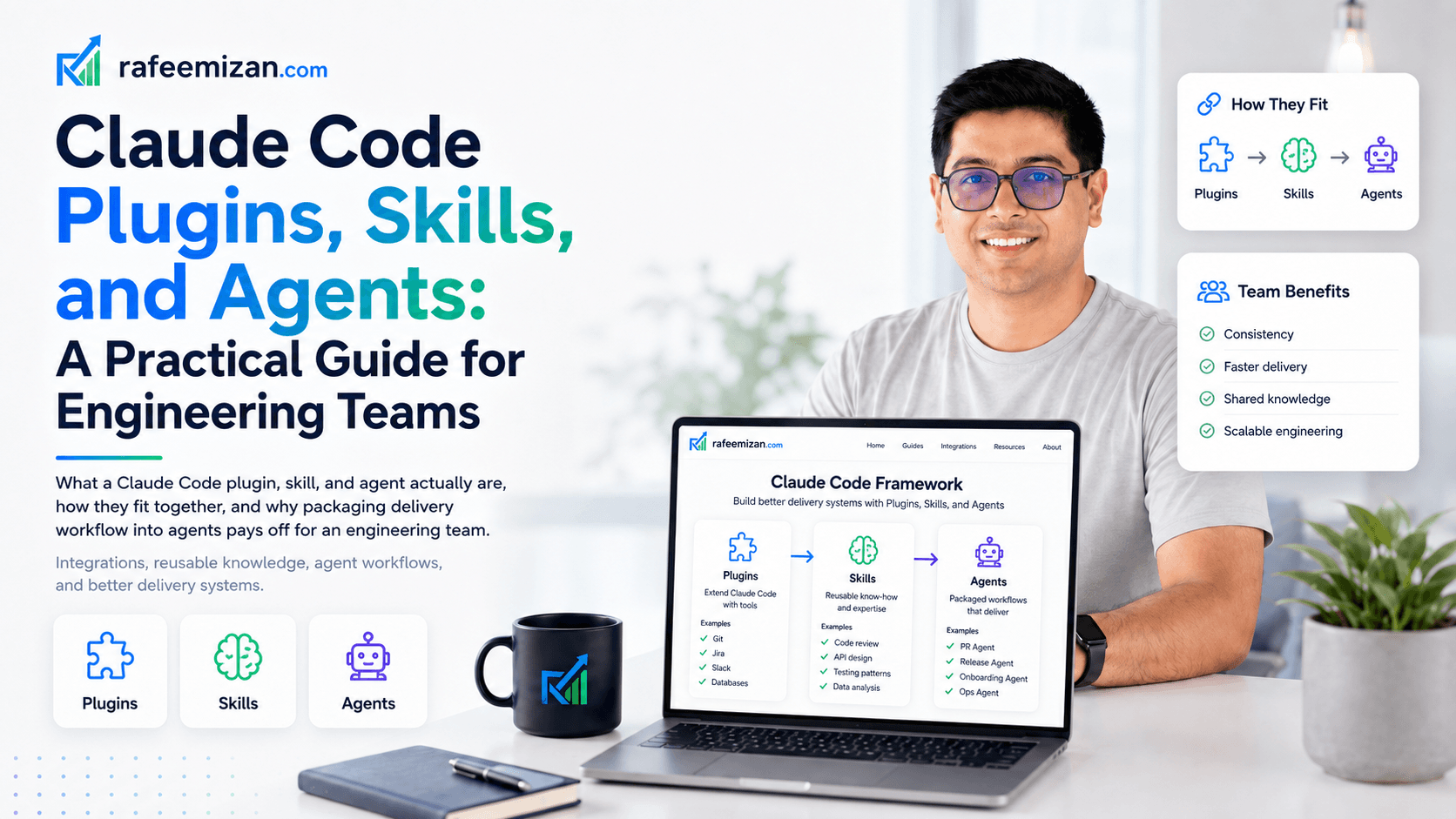
The alternative is packaging it once, so it applies the same way no matter who's driving. That's what skills, agents, and plugins are for in Claude Code, and it's worth being precise about what each one actually is, because they solve different parts of the same problem.
What is a skill
A skill is a packaged, reusable set of instructions for one recurring job. Writing Schema.org markup for a blog post. Reviewing a PR against a specific set of conventions. Auditing a page's on-page SEO. Each of these is something you'd otherwise explain from scratch in a prompt every time, and each time you'd phrase it slightly differently and get a slightly different result.
A skill fixes that. You write the process once, the model triggers it either by name or by matching the intent of what you asked for, and it applies the same way every time. It's versioned, it's shared across a team, and it keeps working after the person who wrote it has moved on to something else. The difference between a skill and a good prompt is the difference between a documented process and a verbal instruction, one survives the person who gave it.
What is an agent
An agent is a role-scoped worker with its own tool access and its own system prompt. A code reviewer agent that can read a diff and leave comments but can never edit the code it's reviewing. A QA agent that can run the test suite but has no permission to deploy. A schema auditor that can fetch a live page and score it but can't touch the site.
That tool boundary is the actual point, not a formality. A reviewer that literally cannot commit code is a reviewer you can trust to be honest about what it finds, because there's no shortcut where it just fixes the thing instead of flagging it. An agent can run standalone, or get orchestrated by another agent, a project lead calling a QA agent calling a reviewer, each one doing its one job and handing off.
What is a plugin
A plugin is the packaging format. It bundles a set of skills and agents, and often a few commands, into one installable, versioned unit a team can share. Instead of every developer keeping their own private stash of prompts they've refined over months, the whole team installs the same plugin and gets the same behavior. When someone improves a skill, everyone benefits from the fix, not just the person who happened to hit the edge case.
A word on MCP
Skills, agents, and plugins are how Claude organizes its own behavior. MCP, the Model Context Protocol, is how it reaches outside itself. It's the protocol that lets Claude call an external system, a CMS, an ERP, a ticketing tool, as a tool it can use directly. If a plugin is the process, MCP is the wiring that lets that process touch the actual systems a business runs on. Worth knowing the distinction exists, but it's a separate topic from what's covered here.
Why agents specifically pay off
A few reasons this is worth the setup cost.
Determinism. Anything that produces a score or a checklist should not be re-derived in prose every single time. Push it into code with a real exit status instead, and the same input gives you the same output on every run. An audit tool that scores a page differently on two runs is worthless for client reporting, and the fix isn't a better prompt, it's moving that logic out of the model entirely.
Safety through tool restriction. A reviewer or auditor agent that literally cannot edit what it's reviewing gives you an honest opinion, not a silently self-corrected one.
Parallelizability. Run the same audit agent across fifty URLs at once instead of one at a time. That's not something a single chat conversation can do.
Consistency across a team. The same conventions apply whether it's the most senior engineer or the newest hire driving the assistant, because the process lives in the skill, not in whoever's typing.
And a real review loop still matters. None of this replaces a human owning the architecture, the scope, and the merge gate. The agent is an implementation partner, not the one deciding what gets built or whether it's good enough to ship.
A short real-world example
I built an internal Claude Code plugin like this for a software delivery studio, delivery agents and shared skills covering requirements, code review, QA, and release, plus a structured-data and on-page SEO auditing system. What started as a single schema-markup skill grew into a three-skill SEO auditor with a deterministic scoring engine and over a hundred automated tests behind it. Review surfaced two real correctness bugs along the way, not stylistic nitpicks, actual defects that would have shipped otherwise. More on that in the case study.
Getting started
Start with one painful, repeated task as your first skill, not an ambitious system covering everything at once. Let a real review loop, human or automated, surface the gaps instead of trying to anticipate every edge case up front, you won't think of them all sitting alone with a blank file. The moment anything score-like or checklist-like stabilizes, move it into code so it stops drifting between runs. And keep a human owning the architecture and the merge gate the whole time.
None of this is about handing over control. It's about not spending that control re-explaining the same thing every single day.