My LinkedIn feed has a new genre of post. Someone has built a "complete AI marketing team" inside Claude Code, fifty specialized agents, a hundred-plus skills, ten departments from SEO to RevOps, all yours if you comment "AGENTS" below. The screenshots look impressive, a neat folder tree, a terminal full of green checkmarks, a promise that you can replace a marketing department with a repo.
I build Claude Code plugins, skills, and agents for a living, and I work in B2B marketing, so I wanted an honest answer instead of a gut reaction. Do these setups actually move pipeline, or do they just move text faster? I went through the 2025 and 2026 analyst research, the GitHub repositories people keep sharing, and the practitioner write-ups, and the answer is clearer than the hype suggests.
The short version, AI agents cut drafting time, they don't cut strategic risk. And the setups that hold up in real B2B work look nothing like a fifty-agent folder.
Adoption is nearly universal, results are not
Budgets have already moved. B2BMX Insights' 2026 benchmark report found 60.4% of B2B marketers are increasing spend on AI tools, more than are increasing spend on account-based marketing, which used to be the top growth line. Gartner's October 2025 survey of 413 martech leaders found 81% piloting or implementing AI agents.
The gap shows up the moment you measure outcomes instead of output.
- 87% of marketers using AI content tools report higher productivity (Content Marketing Institute, 2026)
- 39% report better content performance (same research)
- 45% of martech leaders say vendor-offered AI agents fail to meet the business performance they were promised (Gartner, Oct 2025)
- 35.9% use AI across multiple workflows, not just one
- 30% of marketing teams are ready to scale AI, even though they spend an average 15.3% of the marketing budget on it (Gartner 2026 CMO Spend Survey)
Read the first two lines together. Almost nine in ten teams feel faster, fewer than four in ten see the content perform better. That's the whole story of AI in B2B marketing right now, more output, roughly the same results. Gartner goes further and predicts that over 40% of agentic AI projects will be canceled by the end of 2027, because of rising costs, unclear business value, or weak risk controls.
None of that says AI is useless in marketing. It says volume was never the bottleneck.
Why the fifty-agent packs break
A fifty-agent marketing team in Claude Code is, mechanically, a folder of Markdown files. Each "agent" is a system prompt, each "skill" is a SKILL.md with instructions for one job. I've written plenty of both, and they're genuinely useful, I explained how they fit together in Claude Code Plugins, Skills, and Agents. But calling them a team skips over three problems that show up the first week you try to run real marketing on them.
Skills are instructions, not access. A skill can teach Claude the shape of a good Google Ads audit, it can't log into your Google Ads account. Without an authenticated connection to HubSpot, GA4, Search Console, or your ad platforms, usually through an official MCP server, a fifty-agent folder is a well-organized prompt library working off whatever CSV you pasted in. Synter's 2026 analysis of marketing skills makes the same point, the gap skills don't close is execution against live data.
Your data isn't ready, and live write access is dangerous. Half the martech leaders in Gartner's survey said they lack the data and technical stack readiness to deploy agents at all. And the teams that do wire agents into a live CRM or ad account take on a new kind of risk, an unconstrained agent can overwrite contact properties, enroll the wrong list in a nurture sequence, or spend a daily ad budget on a bad assumption. Nobody's LinkedIn screenshot shows the permission scopes.
Unverified volume costs you trust with buyers. Forrester's 2027 B2B predictions expect AI agents to influence 75% of B2B purchase decisions, and in the same breath expect buyers to double the human verification they do, with two-thirds of providers at risk of losing deals when their claims can't be verified. B2B buyers are already drowning in generic content. Fifty agents producing more of it, lightly reviewed, accelerates exactly the thing buyers have learned to ignore.
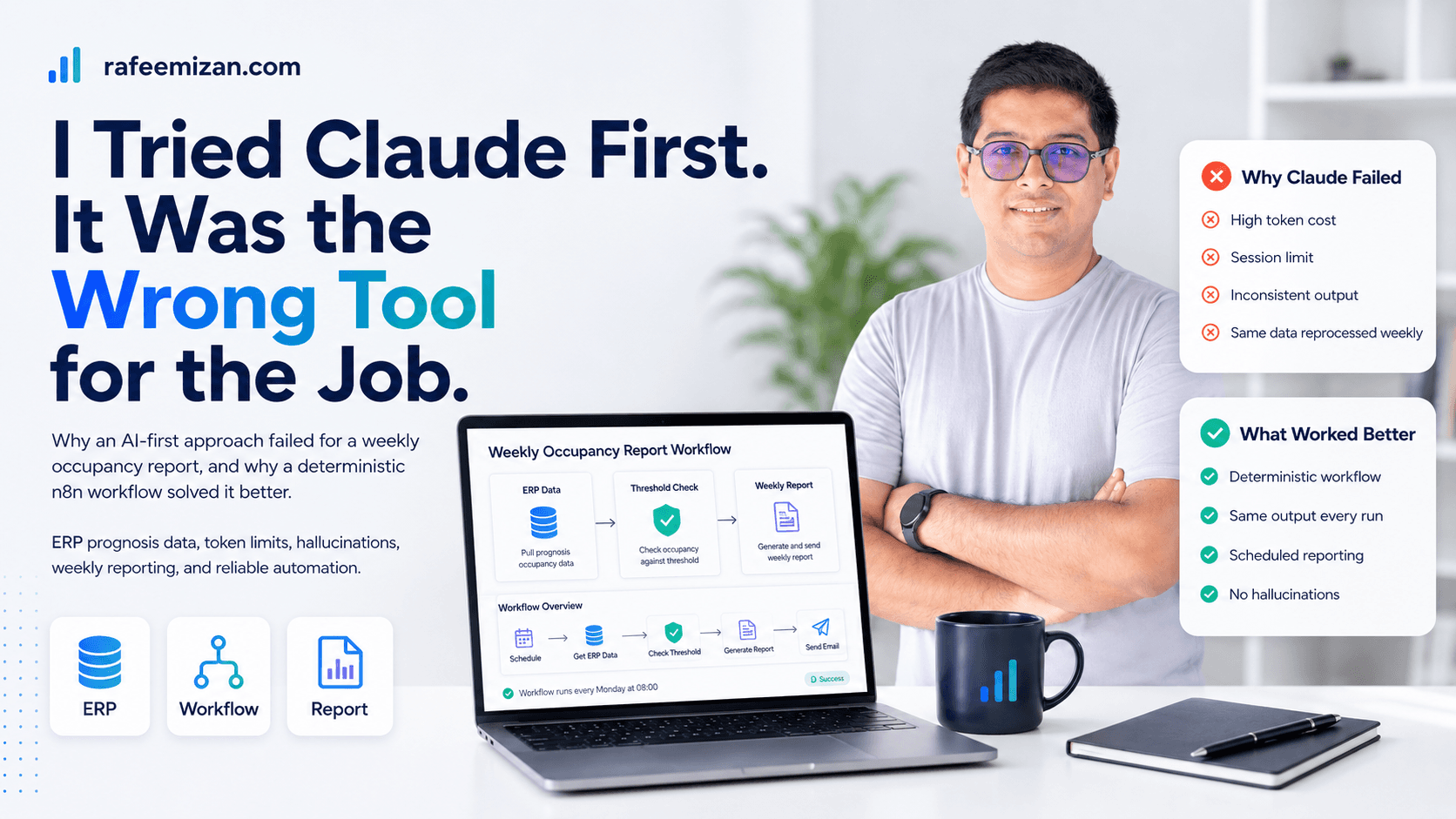
There's a fourth problem I'd add from my own experience, cost and consistency. I once tried to run a recurring data job through Claude over MCP, and one pass burned an entire five-hour session limit, then gave different numbers on the next run. I moved it to n8n and it just worked, I wrote that up in I Tried Claude First. It Was the Wrong Tool for the Job. A marketing department is full of jobs like that, weekly reports, enrichment, monitoring, and none of them need a model's judgment every time they run.
What a reliable setup actually looks like
No single plugin runs a B2B marketing department reliably. The setups that hold up separate three layers, and keep a human at the end of each one.
- Skills for the frameworks. How to write a positioning statement, structure a landing page, audit technical SEO. Static, versioned, shared across the team.
- Official MCP connectors for live data. Authenticated, vendor-hosted, scoped. Read-only first, writes only behind an approval.
- A deterministic workflow engine for anything recurring. Scheduled jobs with branching and error logs, not an interactive terminal session someone has to remember to start.
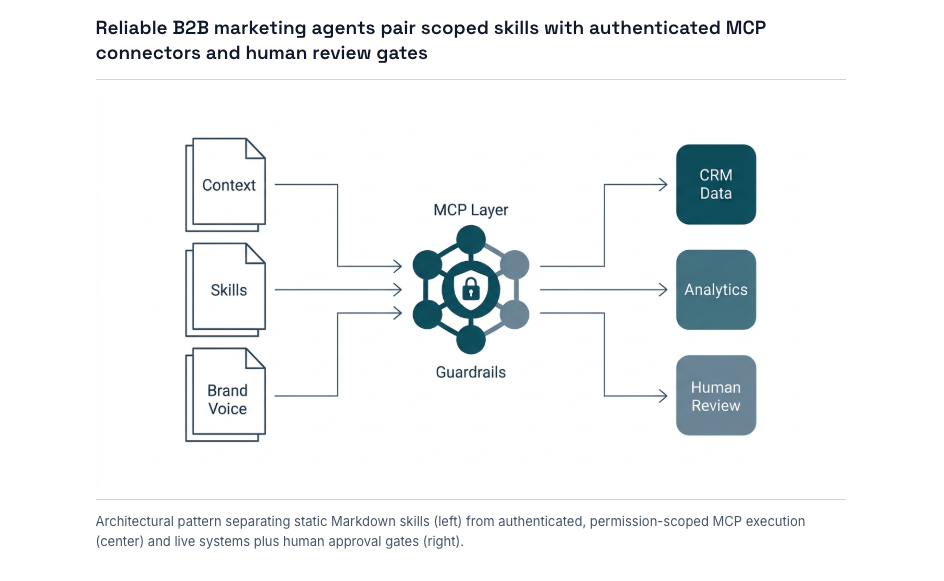
Mapped to the tools that are actually well maintained right now:
| Tool | Role | Why it's reliable | Best fit and trade-off |
|---|---|---|---|
| Anthropic Marketing plugin Best official baseline | Skills plus MCP connectors | Maintained by Anthropic, open source (Apache-2.0) | Ships core marketing skills with connectors for HubSpot, Canva, Figma, Ahrefs, Klaviyo, Amplitude, Notion, and Slack. A starting point, not a finished system, you still add your brand voice and your own connector config. |
| marketingskills by Corey Haines Best open-source library | Structured marketing skills | Most mature open-source library, MIT, trigger evals | 50+ skills from CRO to cold email to RevOps, all built around one shared product-marketing context file. No live execution on its own, needs MCP servers for anything account-level. |
| claude-seo Best SEO and GEO specialist | Technical SEO and AI-search audits | Focused scope, MIT, runs locally | Crawlability, schema, E-E-A-T, and GEO checks, with optional free Google APIs, producing a report a human reviews. Full-site audits are token-heavy. |
| Vendor MCP servers Best live execution layer | Authenticated CRM and outbound APIs | Vendor-hosted OAuth, scoped read and write | HubSpot, Zapier, Smartlead and similar give Claude live CRM and campaign data without CSV exports. Start read-only and gate every write behind a human. |
| n8n and Clay Best for scheduled ops | Deterministic workflows and enrichment | Branching, error logs, same output every run | CXL recommends both for recurring B2B jobs, weekly reporting, AI-visibility monitoring, and enrichment. Less flexible than a chat, which is the point. |
Notice what's missing from that table, anything that calls itself a team. The reliable pieces are narrow, and they're reliable because they're narrow.
Start with three workflows, not fifty agents
The rollout pattern in the practitioner guides I read, CXL and SyncGTM among them, lines up with how I'd do it anyway.
Week one, shared context. Install the official Marketing plugin or marketingskills, then write one canonical product-marketing context file, your ICP, positioning, proof points, and the buzzwords you never want to see. This single file does more for output quality than any number of extra agents, because every skill reads from it.
Week two, read-only live data. Connect one official MCP server, usually your CRM or GA4 and Search Console, in read-only mode. Run a weekly funnel-health digest or a claude-seo site audit, and have a person review it before anyone acts on it.
Week three onward, guarded automation. Move the jobs that repeat every week, enrichment, reporting, competitor monitoring, into n8n or Clay, with explicit approval gates. Track pipeline conversion, not the number of assets produced.
If those three workflows don't show a measurable lift, fifty more agents won't either.
The honest assessment
AI agents genuinely work in B2B marketing today for bounded, repeatable jobs with a clear right answer, technical SEO audits, CRM pipeline reporting, account enrichment, and first drafts grounded in a documented brand voice. They break when you hand them a whole department, no live data, and no human gate, because unchecked autonomy amplifies wrong claims, token costs, and the kind of generic copy B2B buyers scroll past.
Gartner's own framing is the right one. The hard part isn't making agents more capable, it's making them reliable enough to earn more autonomy, inside clear accountability.
A folder of fifty agents is a prompt library, not a marketing team. Three audited workflows that touch real data and end with a human sign-off will beat it every time.
Sources
- Gartner, 45% of martech leaders say vendor-offered AI agents fail to meet expectations (Oct 2025)
- Gartner, AI agent reality check: reliability, not autonomy (Oct 2026)
- MarketScale, AI pushes ABM out of first place in B2B marketing budgets, covering B2BMX Insights 2026, CMI, Gartner CMO Spend Survey, and Forrester 2027 predictions (Nov 2026)
- Anthropic, knowledge-work-plugins (GitHub)
- Corey Haines, marketingskills (GitHub)
- Daniel Agrici, claude-seo (GitHub)
- Synter, Best marketing skills for AI agents in 2026: the gap skills don't close (Jun 2026)
- CXL, 15 best AI marketing tools for B2B teams (Nov 2026)
- GetMinds, Best MCP servers for marketing and research agents (May 2026)
- SyncGTM, Claude Code pipeline reporting (May 2026)
- Smartlead, Best MCP servers for sales teams (Nov 2026)